Remembering Jim Durocher

JIM DUROCHER 1983-2014
 It’s noon and I’ve just woken up to the sound of a phone call. Last night I barely slept, and I don’t know why. It was one of those nights where the billion irrational fears you’ve kept locked up throughout the day join hands to ram through the doors and roam your mind. Amongst them was the fear that Jim wasn’t doing alright. I was supposed to pick him up last night to bring him to Des Moines. But he didn’t answer my call. I look at my phone and see that today’s missed call is from his mom.
What I found interesting about Jim at the time was that within the rather small sphere of my home-schooled friends, he was one of the very few people who would rather draw pictures than play sports. He didn’t care about being perceived as weird. He just wanted to do what he was interested in doing. As many of my hours were then spent in my room toiling away at elaborate pieces of art which few people understood, I connected with him quickly.
We would get together and make comics, each taking turns drawing the characters. We’d dare to listen to music that didn’t come from Christian book stores, and we’d try to figure out how to play it on our guitars. It was the homeschooled version of teenage rebellion. And oh, it was glorious. But it didn’t last long.
As must be the case everywhere, sooner or later the weirdos meet the jocks, and chaos erupts. Our particular nemesis was a fellow named Doug. Doug was clean-cut. Doug was popular. Doug could run long distances at speeds imperceivable by the human eye. And Doug, predictably, did not like us. After months of his mocking remarks, Jim and I decided to get him back in the form we excelled at. One day after our class was over, we handed him an absurd comic depicting him sneaking into West Point and getting gunned down by cartoon ducks.
As one might imagine, our brilliant plan did not go over so well. But it went over much worse than most would think. Soon after the comic’s delivery, it was assumed that Jim and I were actually planning to murder Doug (sans cartoon ducks), which resulted in me being sent to a string of counseling sessions and Jim reciting a written apology to Doug on his front lawn. Never again did our study group meet. Beyond that, our dark sense of humor had rattled our parents and given them cause to keep us away from each other, so Jim and I fell out of contact with each other for more than a decade.
“Trying to get back on your feet
They’re just not on the ground
And the frustrating thing is
Your head’s not even in the clouds”
Jim’s appearance had changed substantially when I caught up with him in the fall of 2011. His hair was much longer, his frame notably thinner, and his voice was marked by a continuous undercurrent of gravel. The evening we reunited found us in a friend’s back yard, cracking jokes, sharing the contrasting music we’d been creating, and connecting over the loss of long-term relationships we each had been in over the past few years. We’d been dealing with the resultant pain quite differently.
As he explained it to me, his breakup had spurred an alcohol addiction that sent him in and out of rehab clinics over the past couple of years, but at this point his alcoholism had cut ties with past tragedies and was now its own monster. It was only a few days after he’d been released from his most recent recovery session that he’d called. He talked about how he knew that he needed to quit drinking, but also about how he had no desire to do that. He understood that it might kill him, but he also said he had no fear of death. It was something he’d talk about many times over the following years, a statement imbued simultaneously with frustrating and admirable qualities. He told me several times that he didn’t think dying would be that bad, that in many ways he’d said what he needed to say and done all he wanted to do. I, of course, argued that he still had plenty to give, but he wasn’t completely convinced.
A few weeks later, I got another call from him, informing me that he was now in a mental institute — one of several he’d spend the next two years inside. I’d visit him twice a month, and often I’d be allowed to take him out for dinner. The early outings were difficult in that Jim would frequently try to convince me to let him buy himself beer or pills, but that slowly changed over the course of many months. Eventually, we developed a routine. I’d pick him up in the evening, and we’d go out for a game of pool. Jim would buy a non-alcoholic beer, and we’d have the sort of fun we used to have in high school, without substances standing between us. There were ups and downs over the course of those years — there were some long, hard nights when he’d brood over thoughts of suicide — but the general direction was one of progress. The more we were able to get out of the mental institute, the more Jim grew to remember what having fun without alcohol was like.
“If that song upset you, then you might want to go. Because there’s more where that came from.”
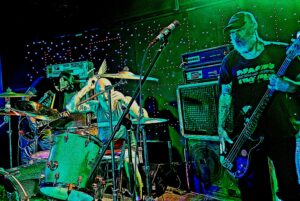
Aiding Jim’s fight against addiction was the steady headway we were making on an album recorded under The Twelve Canons moniker. By then, Jim had used that name for over a decade. Along with Alex Body and Sam Gold, the Canons had become well known in Iowa City for their raucous live performances and horrifying-yet-poignant lyrics. As both Alex and Sam had moved on to other projects, we decided it was probably time for the two of us to collaborate.
Having come from a much less dark musical background, I found myself somewhat hesitant about working on such grim material. “There’s No Getting Out”, for instance, is written from the standpoint of a remorseless killer, and I often wondered why Jim, one of the gentlest people I’ve ever met, would have a desire to write something like that. He told me at some point during the recording process that he took on the personas of vile men in order to examine and mock them, that it was kind of like writing Disney villain songs. Then it clicked for me.
The composition came much easier after that, and our collaboration on songs like “High Ho” were some of the best examples of us having a mutual understanding of what the music ought to be doing. Those songs were different from anything I’d worked on before, in that they not only involved an honest emotional examination of difficult topics, but also plenty of dark humor. The song “Sacrifice”, for instance, has a bridge full of completely nonsensical gibberish. We’d get done recording vocals for a song and Jim would laugh, saying “oh my god, these lyrics are so mean!” Then we’d try another take and see if we could get it to sound even scarier.
Adding to the hilarity was the experience of recording all of this at a mental institute. The room we were given adjoined a noisy hallway, and we were never allowed to close the door thanks to the Abbe Center’s rules. So at any point during the recording, someone could burst in to investigate the odd noises echoing down the hall. For “Sacrifice”, Jim told me he wanted the song to sound like it was being performed inside a “rowdy pirate bar”. This led to us taping several layers of whooping, grunting, and fist pounding, which attracted the attention of other residents. During the recording of one take, a confused man rushed in and smacked Jim in the face — an event he often looked back on with amusement.
We started out recording the scary songs and the funny ones, but eventually we worked our way to the heartbreaking material. If people mostly remember Jim’s music for how horrifying it was, “The Spirit of Pregnancy and You in the Nude” provides ample proof of how hopeful it could also be. It’s here that Jim’s soul really seemed to shine out of his writing, revealing more of what it was like to know him personally. It wasn’t him putting on the mask of a character for the sake of humor or horror. It was just him.
In that particular case, he sang of his addiction, “My baby / my little child / it’s been in me / for quite awhile / Look what it’s done to me / look what it’s done / it’s taken my beauty / and now I have none”, and then of leaving it behind: “You in the nude / They’ll see your true face / shining through / So just take it off / and take it all off / and show that skin / beneath the soiled cloth”. This song, and “I Guess It’s True What They Say” — sung to me first after a particularly bad night of depression — are the tracks that will stick with me whenever I remember Jim and the music we made together.
“The line between reality and my delusions is kind of beginning to blur. . .where do I cross the line into delusional thoughts when I think that I am being watched and maybe just have delusions of grandeur?”
Today, I am sitting in the room we would have recorded our next album in and I’m listening to the sound of his voice playing back through old recordings. I’m watching him joke with the crowd at old concerts, and I’m watching audiences roar with applause.
The night before I got the phone call, I’d called Jim about going to pick him up, but he didn’t answer. A week prior, he told me that he’d finally nailed down the first batch of songs on the list we’d made together, which would comprise the next album. He told me that he was tired of writing songs that were so dark. He’d finally put together some material that was more forward-looking, more upbeat. But those last songs were never heard, never recorded. My phone call went straight to voicemail.
Now I’m sitting here, writing this out, and I’m wondering what image of Jim I ought to leave people with. The difficult thing about summing up a person’s life in a piece of writing is that there is so much to say and, as you may now have noticed, much of the time I knew Jim, his life was overcast with struggle and tragedy. It would be dishonest to hide that. But there were bright spots that broke through that haze, and anyone who knew him personally could readily confirm what a faithful and compassionate friend he was.
Jim was eventually released from the mental institute, and although he turned back to alcohol afterward, his general outlook had changed significantly from when I’d first caught up with him three years prior. He was more positive, and he showed a huge desire to reintegrate with ‘normal society’ after talking almost exclusively with mentally ill people for years. I’d introduce him to my other friends, then we’d step out of the room and he’d ask me, “How was that? Did I do alright?”
Jim was always worrying about how people perceived him. He always wanted them to know he wasn’t as scary as his singing voice. He was unusual, yes, and many, including myself know how it feels to be unusual. But he was also a kind, caring person, who loved his friends, who called them regularly to make sure they were doing alright. He was a brilliant artist whose inimitable music reached dimensions beyond his contemporaries and far fewer ears than he deserved. I don’t know another person remotely like him, and I doubt I ever will. He was Jim, he was my friend, and I wish you could have known him — truly known him — like I did.
I’ve never been as good with words as Jim was, so I’ll let him close us out with the last lyrics he posted to the outside world:
“…have you read your tickets?
It seems that your mind is child like
You ride through the thickets
The same ones you planted
As a child
And when you die
Then, James, oh my
You’ll find your life
Was more than ill spent time”
All of The twelve Canons releases are available as name your own price downloads here:
http://thetwelvecanons.bandcamp.com/