Dylan, Cash and the Nashville Cats
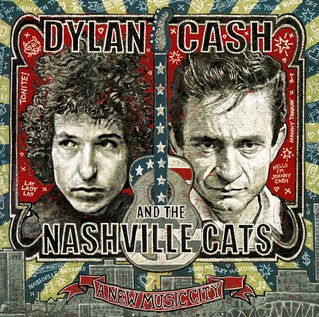
Dylan, Cash and the Nashville Cats
A New Music City
Legacy / CMF; 2015
Nothing succeeds like success. And imitation is the highest form of flattery. Both of these cliches are tantamount to understanding everything which follows. In 1966 Bob Dylan went to Nashville to try something different. Enlisting some of the considerable local talent he produced the seminal Blonde on Blonde album. An unusual artistic move at the time as pretty much the only people to record in Nashville then were country acts. The critical and commercial acclaim which followed Blonde on Blonde forced many other rock, and folk acts to look to music city with a new found appreciation.
This collection chronicles 36 songs from artists as varied as Simon & Garfunkel, (The Boxer), and Neil Young (Heart of Gold), to Leonard Cohen (Bird on the Wire), as well as three post break-up Beatles.
So who are the Nashville Cats? The moniker came from The Lovin’ Spoonful’s number by the same name. For those who need their memories jogged, “Well, there’s thirteen hundred and fifty two Guitar pickers in Nashville.”
The core group of session players (among them Norbert Putnam, Pig Robbins, Kenny Buttrey, and Buddy Spicher), were so collectivly dubbed. Don’t worry if these names don’t register because you’ve heard them on FM radio for the past forty years adding git-tar, fiddle, and pedal steel touches to radio staples and top 20 hits. They helped to blur the lines between country and rock, and they could get just as funky and low down as any Detroit or NYC house band.
Dylan and Cash prove to be a formidable presence here with six songs on the two discs, including their duet on the traditional tune “Girl of the North Country.” Dylan is able to cast an even longer shadow with folk duo Ian & Sylvia serving up his song “This Wheel’s on Fire,” and The Byrds spry rendition of “You Ain’t Going Nowhere.”
Among the less well known numbers which stand out are Charlie McCoy and the Escorts “Harpoon Man,” The Beau Brummels “Turn Around,” and Leon Russel’s endearing version of “Six Pack to Go.” For some this collection will be a great introduction to fascinating period in music history. For others it may well prove to be too narrow a retrospective. It also coincides with an exhibit currently on display at the Country Music Hall of Fame, available in CD format for those who can’t find time to visit.